
Inkster Resident Lookup Records
Each official source answers a narrow question. The Inkster Assessing office and its BSA route are useful for ownership and tax-mailing context, while the Wayne Register of Deeds records a documented property interest. Michigan voter tools are built around registration status and lawful file access, not a citywide name list. Court and vital records add event context, but neither establishes a current home by itself. Treat the record date as part of every answer.
| Record | What It Confirms | Where | Access |
|---|---|---|---|
| Assessment card | Parcel owner, situs and tax-mailing context | Inkster BSA Online | Address, name, or parcel search; live card fields vary |
| Recorded instrument | A recorded transfer or other property interest | Wayne County Public Search | Free name route; expanded access or copies may require payment or office help |
| Voter record | Registration facts allowed by Michigan law | Michigan Voter Information Center | Public status workflow or a scoped MDOS request |
| Court index | Eligible case appearance and published action | MiCOURT Case Search | Informational index; official file remains with the court |
| Vital record | A family or event fact, and a copy when eligible | Michigan MDHHS Vital Records | Statutory eligibility, application, and channel fees apply |
Start with the record closest to the fact in hand. An address usually points first to the assessor card. A marriage, death, or older birth question belongs with the vital-record custodian. A case number or a name paired with a court belongs with MiCOURT and then the clerk. Business or license results can show an affiliation at a filing date, but not a person’s residence.
Note: Matching two dated official records is stronger than treating a single name hit as a current Inkster connection.
Inkster Resident Lookup Cross-Checks
For an owner question, BSA separates the physical situs address from the owner mailing address and legal description. Those are different facts. The city says its online information may not be current, so preserve the search date and parcel number before drawing a conclusion. A principal-residence or homestead exemption can be an owner-occupancy clue, yet it does not identify every person present or prove present-day occupancy. Compare it with a dated deed, directory entry, or other eligible record.
The public Michigan Voter Information Center is the person-centered route for registration and election information. It is not a street-browse tool or a complete public voter file. When a correction is needed, contact the local clerk or Michigan Department of State instead of treating a non-match as a finding about residency.
Michigan’s voter lookup is shown here as the public starting screen for an Inkster resident lookup.
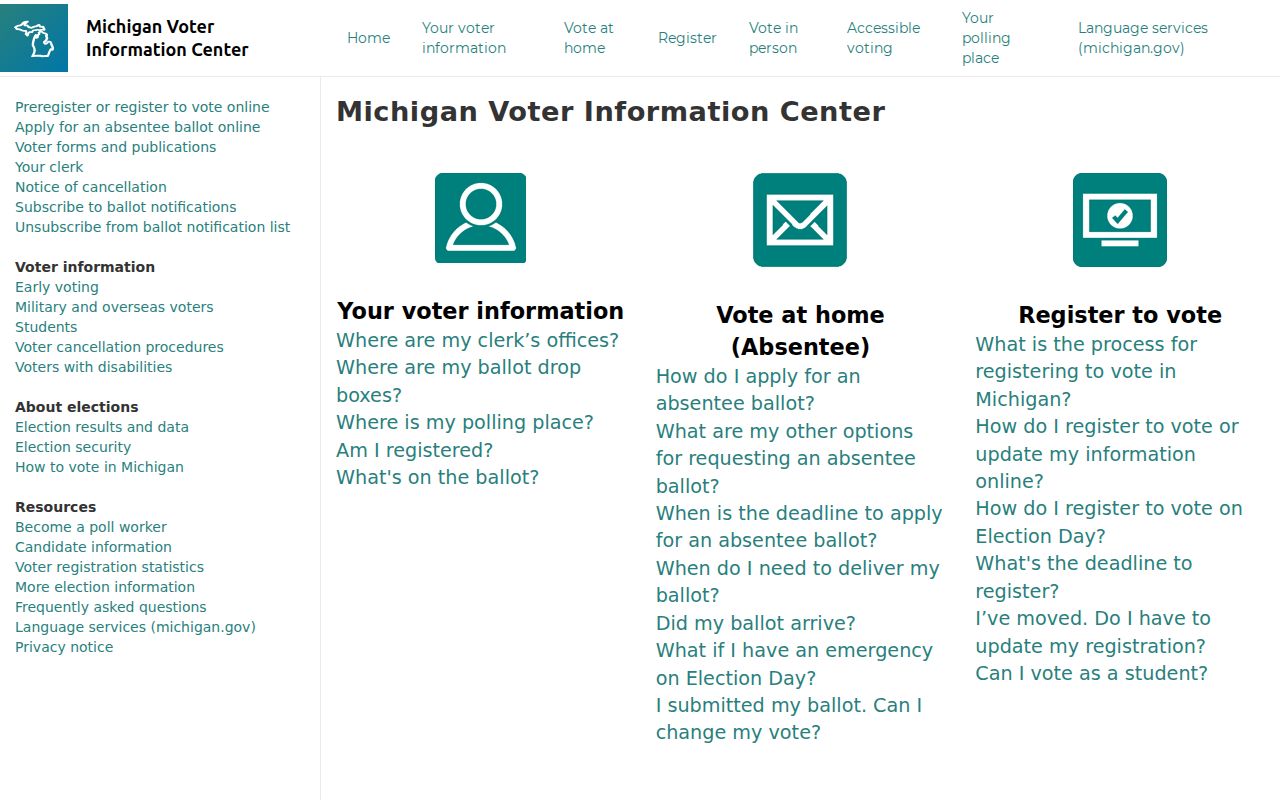
A visible status result still has to be read within its purpose: registration information and election details are not a household roster.
Michigan’s Qualified Voter File is controlled by MCL 168.509p. A full-file request uses the MDOS QVF FOIA form and selects exactly one geography, such as a city or township, district, or one ward and precinct combination. The form also asks for requester identity and a delivery route. It permits pickup, FTP, or mail delivery, not email or a drop-box data delivery. Public material can include names, address fields when available, birth year, status, history, and district codes. Full birth date, driver-license or state-ID number, email, signature, phone, and the last four Social Security digits are withheld.
MiCOURT in Inkster Resident Lookup
The 22nd District Court serves Inkster at 26279 Michigan Avenue, Inkster, MI 48141. Its local site supplies court context, but not a complete public docket search. Use MiCOURT Case Search as the statewide starting point and keep its warning in view: the result is informational, not the official court record. A record can be absent because a court has not loaded that series, the time window differs, the spelling varies, or the case category is excluded.
| MiCOURT field | How to use it |
|---|---|
| Last name or business | Required starting field. |
| First name | Optional refinement for same-name results. |
| Middle name | Optional variant control for same-name results. |
| Birth year | Optional, only when offered and lawfully available. |
| Case year, case number, and case type | Optional routes for a known case or a narrower search. |
| Court selector | Choose the relevant court before comparing any result. |
MiCOURT’s public case-search interface is shown here with the search route used for an Inkster resident lookup.
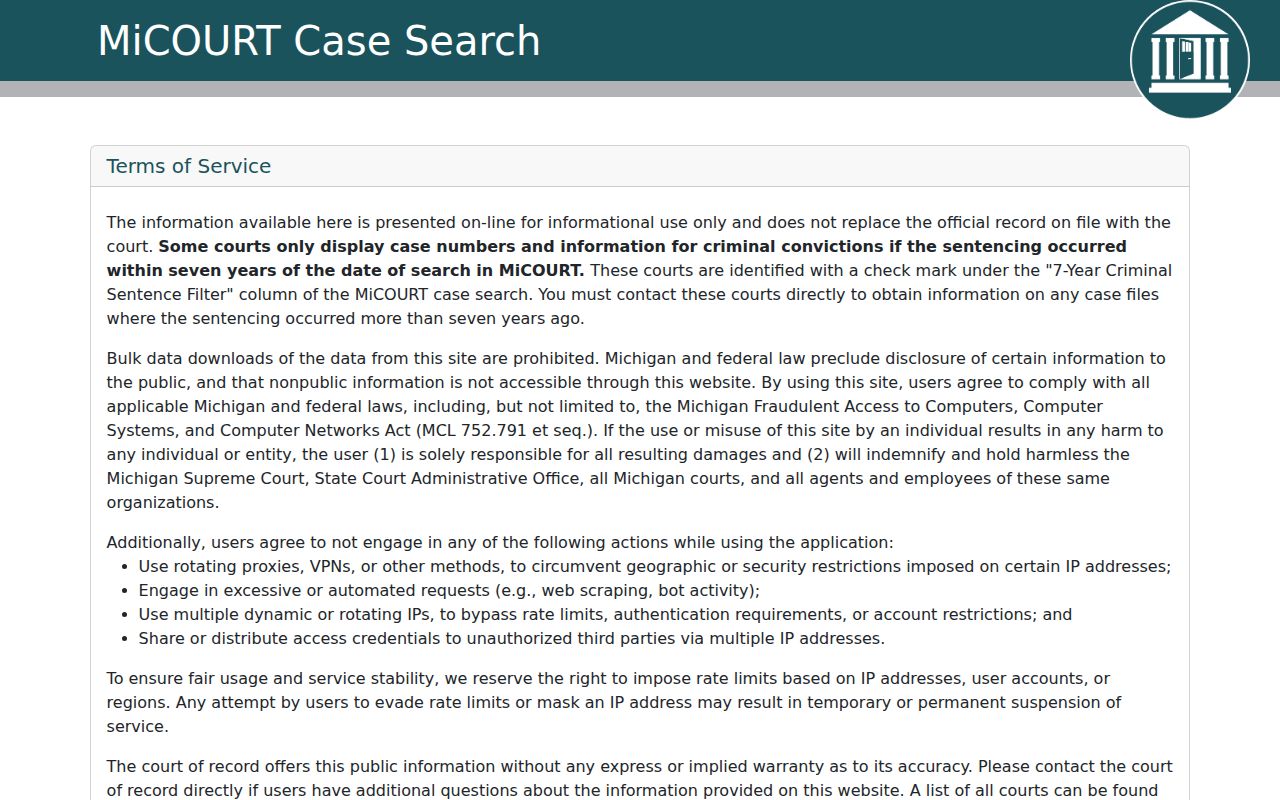
Use the screen to narrow a query, then verify the person through court, dates, party role, and the official file rather than the name alone.
A published result may include case number, court, type, party name and role, filing or case date, action, and disposition. The Michigan Courts structural docket sample also shows alternate names, service and answer dates, attorney, party actions, due dates, and identifiers. It is a structural example, not a claim about an Inkster person. Coverage varies by court, and some courts display criminal convictions only for seven years after sentencing. MiCOURT excludes categories that include adoption, juvenile and CPS matters, juvenile guardianships, mental-illness matters, name changes, parental waivers, PPO matters, surrendered-newborn records, infectious-disease matters, ERPO matters, and young-adult voluntary foster care.
| Published docket item | What it can help distinguish |
|---|---|
| Case number, court, and case type | The case and forum, rather than a name alone. |
| Party role, filing date, and disposition | Whether the same-named party fits the dated case context. |
| Alternate names, service, answer, attorney, and actions | Additional official-file context when the court provides it. |
For civil and divorce files, the Wayne County Clerk records service reports coverage from 1942 forward. Current files are generally in the records room from 2010, while older files are ordered from archives. An order made before 4:30 p.m. may be available the next business day after 2 p.m. and is held five days. The listed uncertified rate is $2 per page. The county’s certification language conflicts, so confirm the current certified-copy charge before ordering.
Note: A missing MiCOURT result can reflect an excluded category, court coverage, time window, spelling difference, or a record held outside the public index.
Verify an Inkster Resident Carefully
Verification works best as a short, ordered trail. Keep alternate spellings, a middle initial, a former surname, and the date beside each result. Stop when records disagree. A service address in a court file can be old, and a registered office in a filing can belong to an agent rather than the person being checked.
- Anchor the name to a dated parcel, directory, or other record that states why it is connected to Inkster.
- Check the public voter status route when the question fits that tool, without trying to infer protected address information.
- Search MiCOURT with name variants, then compare court, case date, party role, and case type before treating a match as the same person.
- Request an official vital or court copy from the custodian only when the event, eligibility, and copy type match the question.
- Docket
- A court’s running list of filings, actions, dates, and case events. It is not a finding that a similarly named person is the person sought.
- Index versus image
- An index points to a record, often with names and dates. An image is the scanned document itself and may have a fee or access rule.
- Certified copy
- A copy issued and certified by the custodian for an official purpose. It is different from an informational screen or ordinary printout.
Historical address evidence needs its own date check. The Inkster city directory collections can help place a person at an earlier address, but an old entry should not be described as present residence.
Inkster Vital Facts and Copies
Michigan MDHHS Vital Records issues birth, death, marriage, and divorce copies. Michigan birth, death, and marriage series generally begin in 1867, while divorce material begins in 1897. For an Inkster event, the Wayne County Clerk offers a local service route, but state eligibility still controls the type of certified copy. A divorce certificate confirms a vital-record fact, not the full court file.
The MDHHS order page is shown here because it identifies the event, requester, supporting documents, delivery method, and payment choices needed for an Inkster resident lookup.
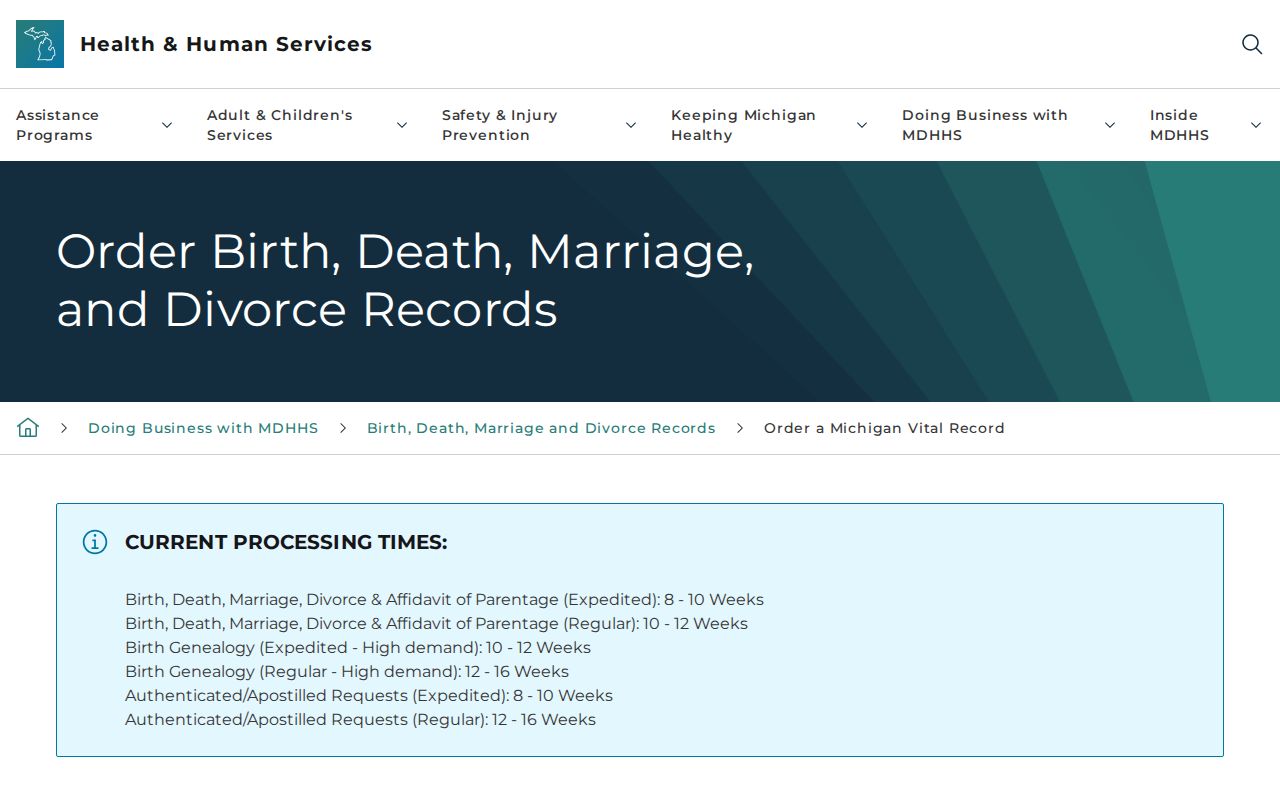
The state form separates an event fact from a certified record and asks for eligibility material where the law requires it.
A birth record under 100 years is restricted to the subject, named parent, guardian, authorized licensed representative, qualified heir, or a person with a court order, with photo identification required. Birth records over 100 years are generally open under state guidance. Death and marriage copies are generally available with application and prepayment; a divorce certificate uses the state procedure, while the complete file comes from the court route. MDHHS lists a standard search or copy charge of $34 and an online processing charge around $14. The available channels include mail, online ordering, phone, Lansing drop box, and appointment or Will Call routes. The Wayne County Clerk One-Stop Vital Statistics counter at 400 Monroe, 6th Floor in Detroit provides a county-facing route for Inkster events. Channel fees and eligibility documents can change the total, so verify the current order screen before sending payment.
Inkster Business Affiliation Checks
The LARA MiBusiness Registry is a useful affiliation source when a name is connected to a Michigan corporation, LLC, limited partnership, LLP, trademark, or other entity. LARA launched the current MiBusiness Registry on June 23, 2025, replacing the older route. Public filing history may identify an entity, registered office or agent, officers or authorized persons, dates, certificates, and document images where available.
Those facts are about the entity at a filing date. They do not prove a person’s home in Inkster. A professional-status question belongs with LARA MiPLUS, which can provide public license status and dates under its own rules. Compare the role and date before connecting either record to an individual.
Note: A registered office, agent, or business contact is an affiliation clue, not a residence finding.
Inkster Safety Registry Boundary
Official safety systems have a defined purpose and should not be treated as a general resident index. The Michigan State Police registry is available for lawful public-safety research and has its own search modes, exclusions, and notices. It does not replace a court file, parcel record, or a proper identity verification. Use a record only for the purpose the custodian states, and do not copy sensitive information into a broader profile.
Michigan’s public safety registry search is shown here as a distinct, purpose-limited resource relevant to an Inkster resident lookup.
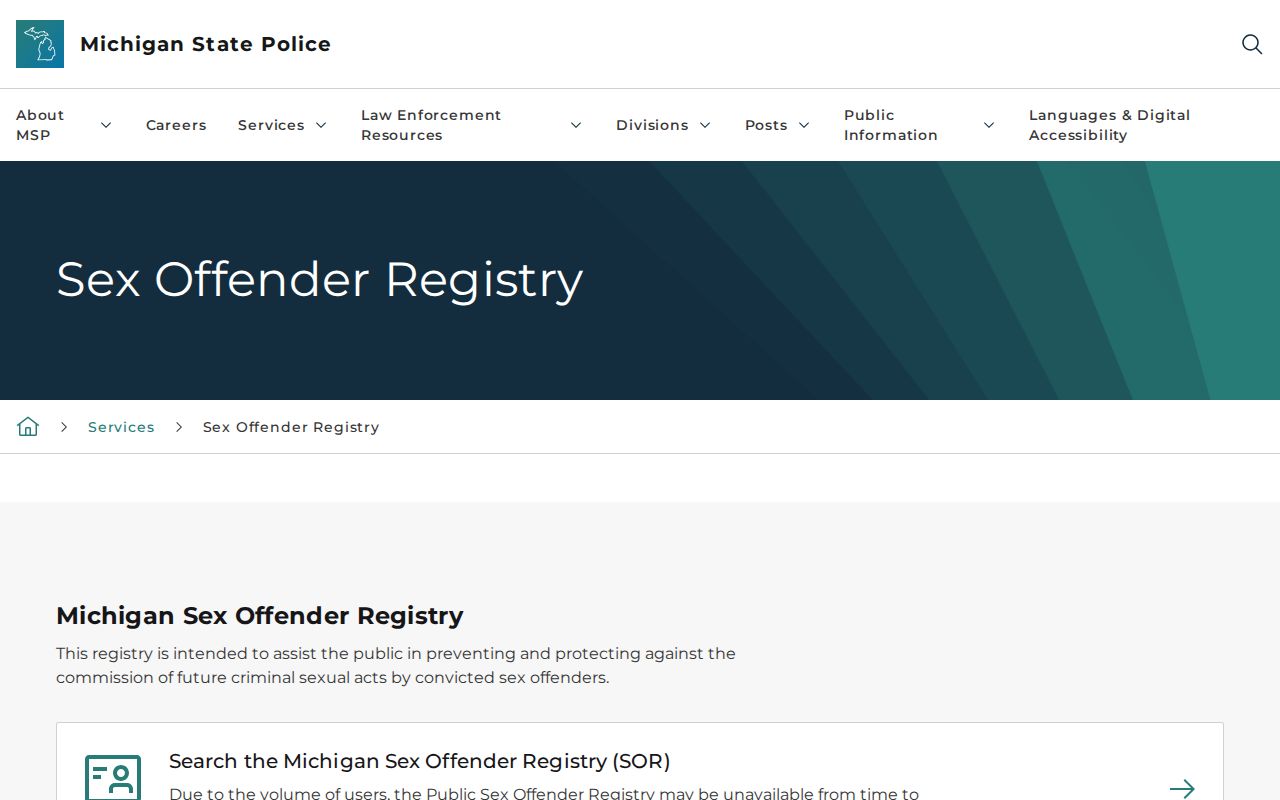
The screen’s separate search and map options underscore that a safety registry is not evidence of ordinary residence or identity.
Inkster Resident Lookup Privacy Limits
Michigan preserves important limits even where a record has public elements. The voter file does not make ballot selections public, and protected voter information must not be reconstructed from partial results. The Michigan Address Confidentiality Program, commonly Safe at Home, is established under Act 301 of 2020 for qualifying survivors of domestic violence, sexual assault, stalking, human trafficking, and people at risk because of those circumstances. Participants receive a substitute address and mail-forwarding protection.
Do not try to determine a Safe at Home participant’s physical address from a voter record, mailing detail, court paper, or map. Non-owner occupants, household members, protected voters, sealed court parties, utility customers, delivery recipients, and unlisted subscribers are not a public roster. An absent name does not establish that someone is not present.
Lawful use. Use an Inkster resident lookup for personal, lawful research such as family history, reconnecting, estate work, civic questions, or avoiding a scam. Never use records to stalk, harass, intimidate, or harm anyone.
Inkster FOIA Record Requests
When no public search exposes the needed record, request only the releasable material that identifies the record. Michigan FOIA, MCL 15.231 through 15.246, allows a sufficiently described written request subject to exemptions, fees, and the response timeline in MCL 15.235. The Inkster FOIA form asks for contact information, date, request category, a specific description, delivery choice, extension consent, signature, and email-copy choice.
Name the department, record type, date range, address or case number, and preferred format. For court material, ask the clerk for the case number and record type rather than requesting everything about a person. For historical material that is not digitized, the library, archives, or county office may offer an in-person or staff-assisted route. Accept lawful redactions and ask the custodian how to correct an identified error.