
Inkster Previous Resident Sources
Previous residents research has two tracks. The ownership track begins with a parcel and deed chain. The household track uses the dated directory, census, obituary, probate, permit, and code evidence that may place someone at the address. Wayne County maintains land instruments, Inkster Assessing maintains property descriptions and maps, and libraries or archives preserve older reference material. The era table keeps each kind of evidence in its proper role.
| Source | Years it covers | Where held | What it shows |
|---|---|---|---|
| Wayne ROD online/current search | Current service page says 1960–present; other ROD text says post-1986 | Portal, Detroit office, or mail route | Recorded deeds and other instruments, subject to index and image access |
| Inkster Polk volumes | 1947, 1951, 1954, 1956, 1958, 1960 | Henry Ford Centennial Library | Dated name and address context |
| West Wayne Bresser volumes | 1961–1977; 1979–1996 | Henry Ford Centennial Library | Reverse address and listed head-of-household context |
| Federal census | Public through 1950 | National Archives and authorized digital access | Household on an enumeration date |
| Permits and code files | Historical start not published | Inkster department request | Project, inspection, or enforcement chronology |
Begin with the parcel and current transfer when the question concerns an address. Start with a dated directory or census when the known fact is a household name. Neither route should be used to assume every person who lived there.
Anchor an Inkster Parcel First
Before looking for past residents, make a dated copy of the current property record. Inkster Assessing says it maintains ownership, property descriptions, maps, legal descriptions, lot sizes, lot splits or combinations, tax estimates, and exemptions. Its BSA Online entry point offers assessment, building, detailed, current tax, and utility-billing service categories, with address, name, and parcel number as visible starting modes. Direct record fields were not fully available in the research inspection, so verify a live result before relying on a field.
Record the owner name exactly as displayed, parcel number, legal description, situs address, owner mailing address, and last transfer date if supplied. A situs address is the physical parcel location. A mailing address is where tax notices go and may be elsewhere. The legal description, such as a subdivision, lot, or block expression, is the steadier bridge when old postal labels change. The Inkster Assessing page also warns that online information may not be accurate or current.
Trace Inkster Deeds Backward
The Wayne County Register of Deeds is the ownership trail for an Inkster address. Search the current owner as grantee, then identify the purchase deed and its seller. Search that seller as grantee to find the earlier purchase, then continue backward. At every link, compare the parcel number and legal description. Check whether the document is a conveyance, rather than a mortgage, lien, release, or correction. A deed date records a transfer, not the date someone moved into a home.
- Use the current assessor record to capture the owner, parcel number, legal description, situs address, mailing address, and any transfer date.
- Search the owner as grantee in the ROD index and save the purchase deed's parties, recording identifier, date, instrument type, and legal description.
- Read the deed's grantor, the seller, then search that seller as grantee to locate the earlier acquisition.
- Repeat the process only when the parcel and legal description match and the instrument actually conveys the property.
- When the online route ends, use the office or mail process with a detailed property description, then compare any result back to the parcel.
- Grantor
- The party transferring an interest in the recorded instrument, often the seller on a deed.
- Grantee
- The party receiving the recorded interest, often the buyer on a deed.
- Chain of title
- The sequence of recorded transfers traced backward or forward for the same parcel.
- Legal description
- The lot, subdivision, block, or boundary wording that identifies land more reliably than a changing street address.
Inkster ROD Search Routes
Wayne offers more than one route, and the free path is narrower than the expanded path. The free public search is chiefly a grantor or grantee name search and returns a listing without full document viewing or printing. The paid on-demand route expands searching to address, legal description, parcel or tax ID, and Liber/Page, while allowing document viewing. In-person searching at 400 Monroe in Detroit and a detailed mail search remain the fallbacks when a name search cannot reach an old address.
The current Wayne ROD Public Search portal is the first online starting point for a party-name check.
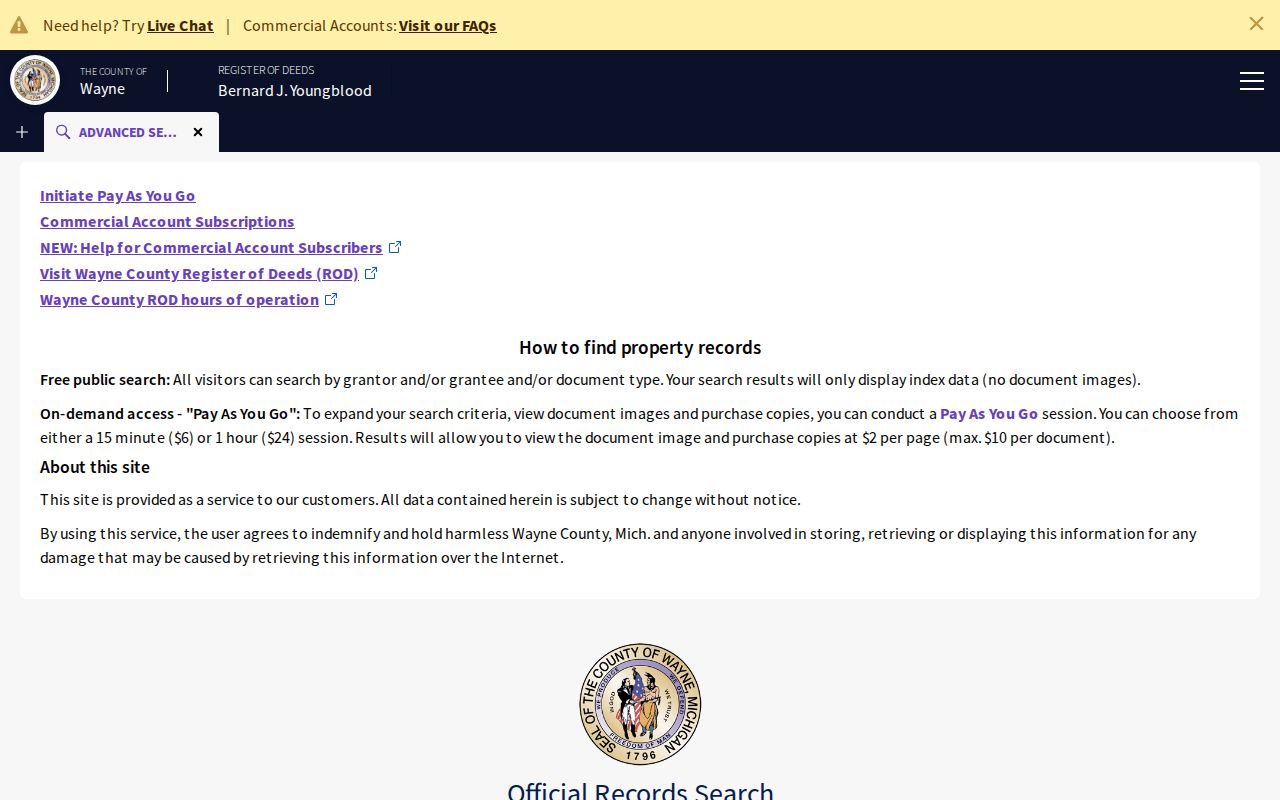
Use a documented result to identify an instrument, then compare its legal description to the Inkster parcel before adding it to a prior-owner sequence.
Note: A seller may be a trust, estate, corporation, lender, or court-appointed party and is not automatically a former occupant.
Inkster Deed Coverage Ambiguity
The county's current search-service page says recorded documents and print copies reach back to January 1, 1960. Other Register of Deeds language refers to online searching after 1986. Treat that as a coverage and image-access ambiguity, not as a single clean cutoff. Document type, index availability, and image access may differ. Records before January 1, 1960 require office or mail research, and later records may still need an account or copy route.
The Wayne ROD search-services page describes the online, office, and mail routes. It lists office kiosks from 8 a.m. to 3 p.m., a $5 property search that is waived for a personal residence with proof, $2-per-page copies, and $10 certification per document. Its mail search is $15 per address plus copy and certification charges, with a detailed description and payment required. Verify current charges before ordering.
The service information makes the fallback chain clear: change the search key, then use expanded access, the Detroit counter, or a detailed mail request.
Inkster Previous Resident Households
Deeds establish a property trail, but previous residents need a household layer. Polk years for Inkster are 1947, 1951, 1954, 1956, 1958, and 1960. West Wayne Bresser volumes cover 1961–1977 and 1979–1996. Regional Bresser books extend across listed years from 1953 through 2008, with gaps. The latter volumes are helpful for an address because their criss-cross sections begin with a street and number. Their listed head is not a complete household roll.
The detailed publishers, holdings, and entry-reading method are kept with the Inkster city directories. Pair an address result with the 1950 census, the newest public federal census under the National Archives release rule. A census gives a household on its enumeration date, while a directory gives a publisher's dated listing. Neither proves a present occupant.
- Choose a documented directory year closest to the deed or address event and search the surname section or criss-cross street section.
- Copy the exact address, name, relationship notation, abbreviation, publisher, year, and page.
- Compare the directory date with a public census year and preserve the jurisdiction label used by each source.
- Use an obituary, probate record, permit, or tax record to test a move, death, transfer, or address change.
Inkster Address Name Bridges
Inkster's civic history can interrupt a simple address search. The city incorporated in 1964, so earlier land and family references may be indexed under Dearborn or Nankin Township. The post office began as Moulin Rouge in 1857 and was renamed Inkster in 1963. Jim Daly Road is now Beech Daly. Test former street names, township labels, postal-city variants, subdivision names, and the legal description before deciding a past-resident trail has ended.
Sanborn maps can add building context by showing footprint, construction material, use, stories, and fire-protection features. The Library of Congress Sanborn guide explains how to search by place, edition, sheet, and map. The official volume finder located Detroit material but no standalone Inkster edition. That is a gap, not evidence that a particular Inkster address appears on Detroit sheets.
Inkster Permit and Probate Endpoints
When a directory or deed chain leaves a gap, ask Inkster for a permit or code file by address and date. Building and planning records can hold project, permit, inspection, and available owner or applicant fields. Code Enforcement has no public searchable case index in the research, so a narrow request should specify the address, date range, case number if known, violation date, disposition, and releasable fields. These files can date construction, additions, demolition, occupancy changes, and inspections, but they do not list every past resident.
Obituaries and probate can close an older trail. An obituary may point to a former address, relatives, funeral home, or date. Wayne's archive guide identifies probate calendars, case files, estate files, wills journals, and registers in distinct date ranges. Confirm an heir or fiduciary against a deed or tax record before treating that person as an owner. No official Inkster house-history service, standalone Sanborn edition, or complete local obituary run was identified, so Leanna Hicks Library, the Historical Commission, and Henry Ford Centennial Library are appropriate confirmation contacts.
Inkster Previous Resident Safety
Property history is most reliable when it stays tied to a dated source and a specific address. The Wayne Property Alert service can send free notices when a real-property filing matches a name, custom keyword, or document. It is a notice of a filing, not a legal determination. It can help an owner monitor recorded activity while the historical research trail remains focused on documents and custodian records.
The Wayne Property Alert service explains the available alert route and its hosted-service disclaimer.
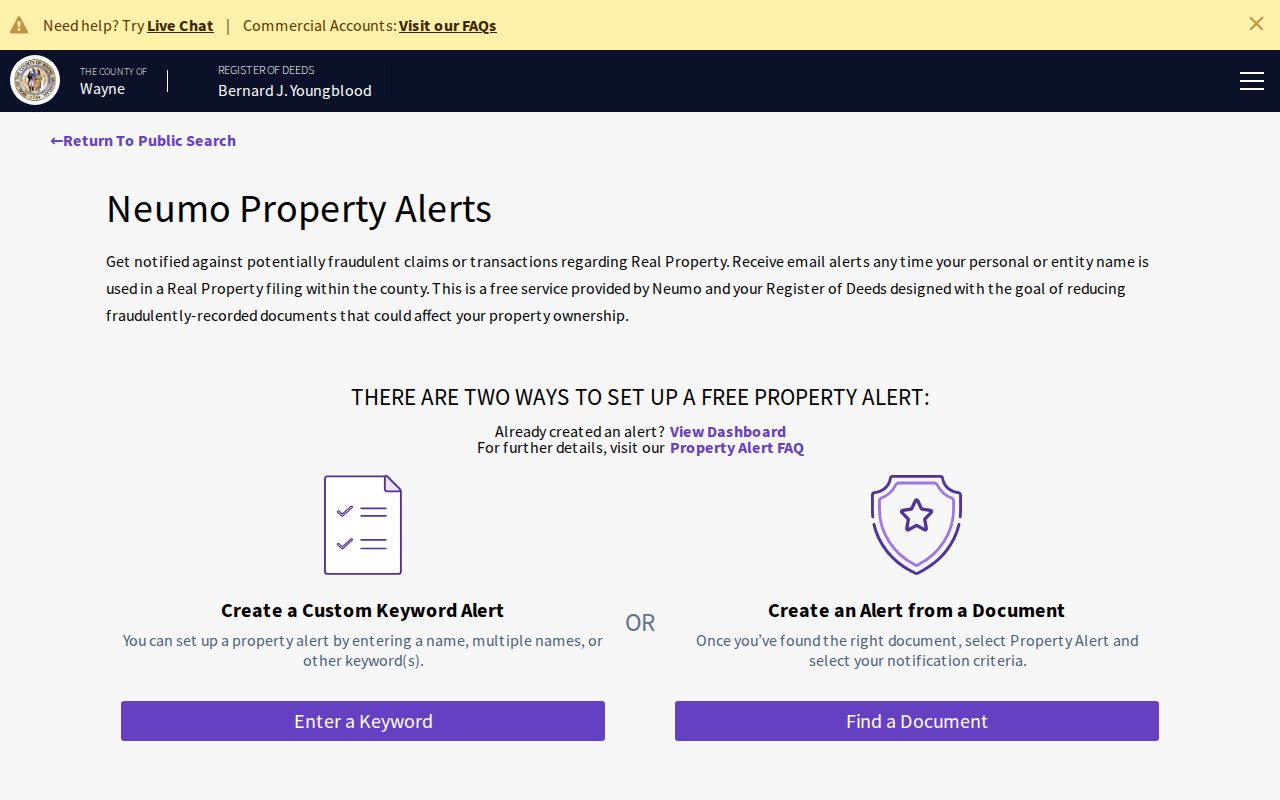
The alert is useful beside a deed review, but it does not prove ownership, occupancy, or the validity of a filing.
Lawful use. Use previous-resident records for family history, property history, estate questions, and personal research. Do not publish the results or use them to track, harass, or harm a living person.